

Containerized Seawater Desalination Equipment Engineering Design
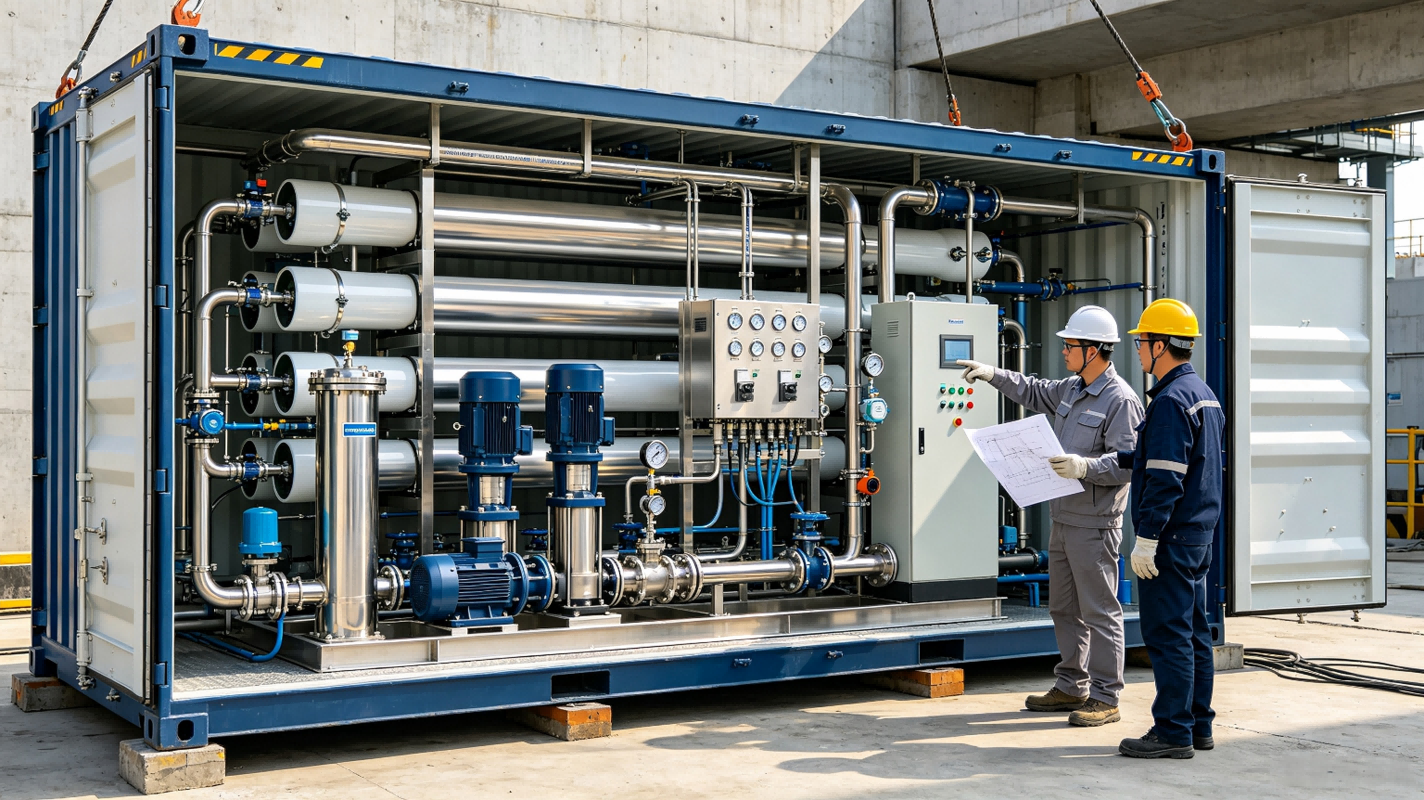
Traditional Seawater Desalination Plants usually require large buildings, extensive infrastructure, and long construction periods. However, many water supply projects are located in areas where land availability, construction conditions, transportation, or installation time are limited. Remote islands, coastal industries, offshore facilities, emergency water supply projects, and temporary construction sites often require a more flexible solution.
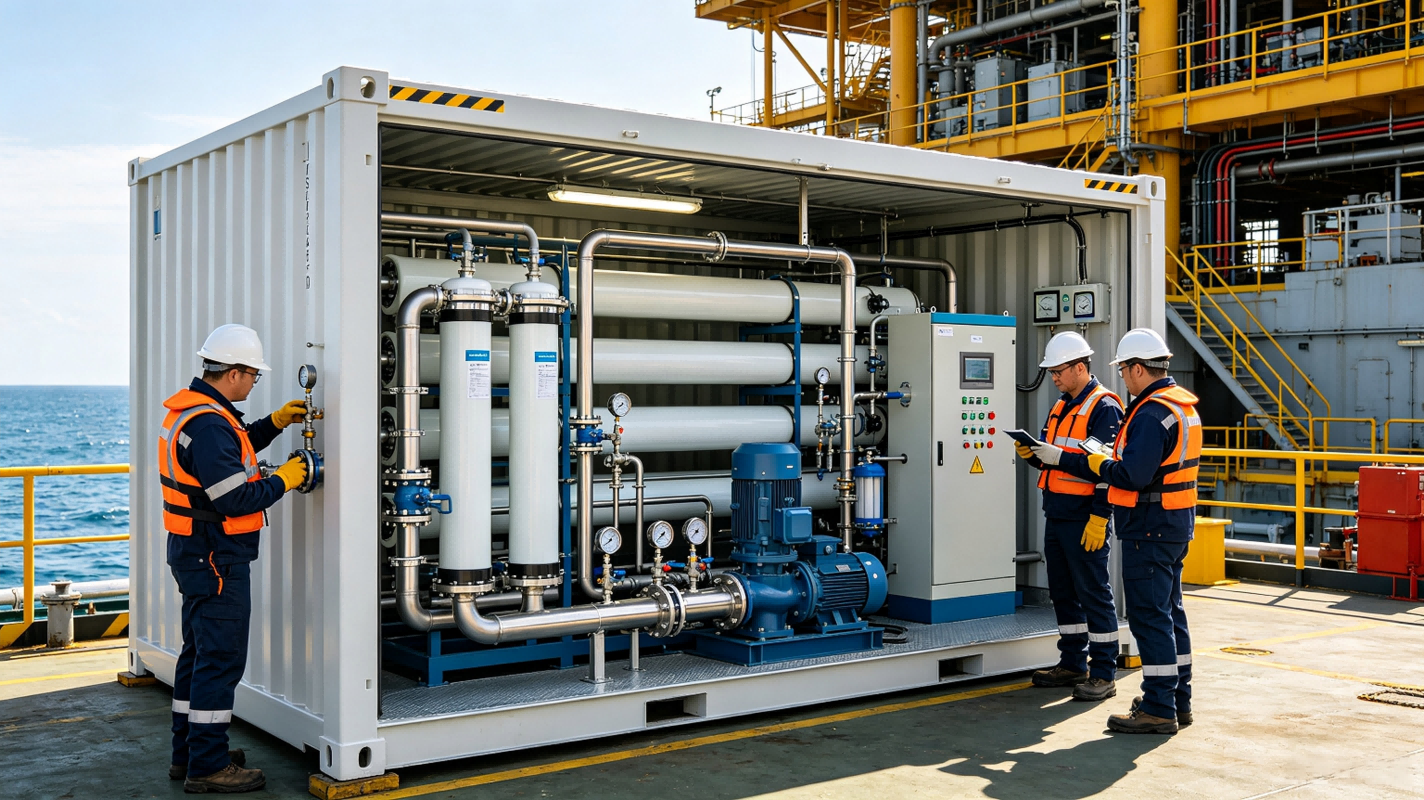
Containerized Seawater Desalination Equipment provides an integrated approach by combining seawater intake, pretreatment, high-pressure pumping, seawater reverse osmosis (SWRO), control systems, and supporting components into a compact modular structure.
Compared with conventional desalination plants, containerized SWRO systems offer advantages in transportation, installation flexibility, equipment integration, and project deployment speed. However, successful engineering design requires more than placing equipment inside a container. Engineers must carefully consider equipment layout, seawater conditions, energy supply, corrosion protection, operation requirements, maintenance access, and long-term reliability.
A well-designed containerized Seawater Desalination System balances compact structure with stable performance, making it suitable for a wide range of freshwater production applications.
What Is Containerized Seawater Desalination Equipment?
Containerized seawater Desalination Equipment is a modular SWRO system installed inside a standardized container or integrated skid structure.
The container acts as both a protective enclosure and a transportation unit. Major treatment components can be assembled, tested, and configured before being delivered to the project site.
A typical Containerized Seawater Desalination System may include:
Seawater intake connections
Pretreatment filtration units
Cartridge filters
High-pressure pumps
Energy recovery devices
RO membrane pressure vessels
Chemical dosing systems
Electrical control cabinets
Monitoring instruments
Freshwater transfer pumps
Internal piping and valves
Depending on the required capacity, multiple container modules can also be combined to increase freshwater production.
This modular design allows engineers to adapt the system for different applications, including:
Island communities
Coastal factories
Hotels and resorts
Offshore platforms
Marine vessels
Emergency water supply
Remote industrial sites
Why Choose Containerized SWRO Systems?
One of the main reasons for selecting containerized desalination equipment is faster project implementation.
Traditional desalination plants often require:
Building construction
Equipment room preparation
Complex piping installation
Long commissioning periods
A containerized system reduces some of these requirements because many components are integrated before transportation.
After arriving at the site, the project mainly requires:
Foundation preparation
Seawater intake connection
Freshwater outlet connection
Power connection
System commissioning
This approach can significantly simplify installation, especially in remote locations.
Many water shortage areas do not have suitable infrastructure for building a complete desalination facility.
Examples include:
Small islands
Temporary project areas
Remote coastal communities
Offshore working sites
Containerized systems reduce the need for large-scale construction because the main treatment equipment is already packaged in a compact structure.
This makes them suitable where space is limited or where permanent buildings are difficult to construct.
Transportation is an important consideration for remote desalination projects.
Containerized equipment can typically be transported by:
Truck
Ship
Offshore supply vessel
Railway
Heavy lifting equipment
Standard container dimensions also make logistics planning easier.
For island and offshore projects, transportation flexibility can greatly influence project feasibility.
Engineering Design Considerations for Containerized SWRO Systems
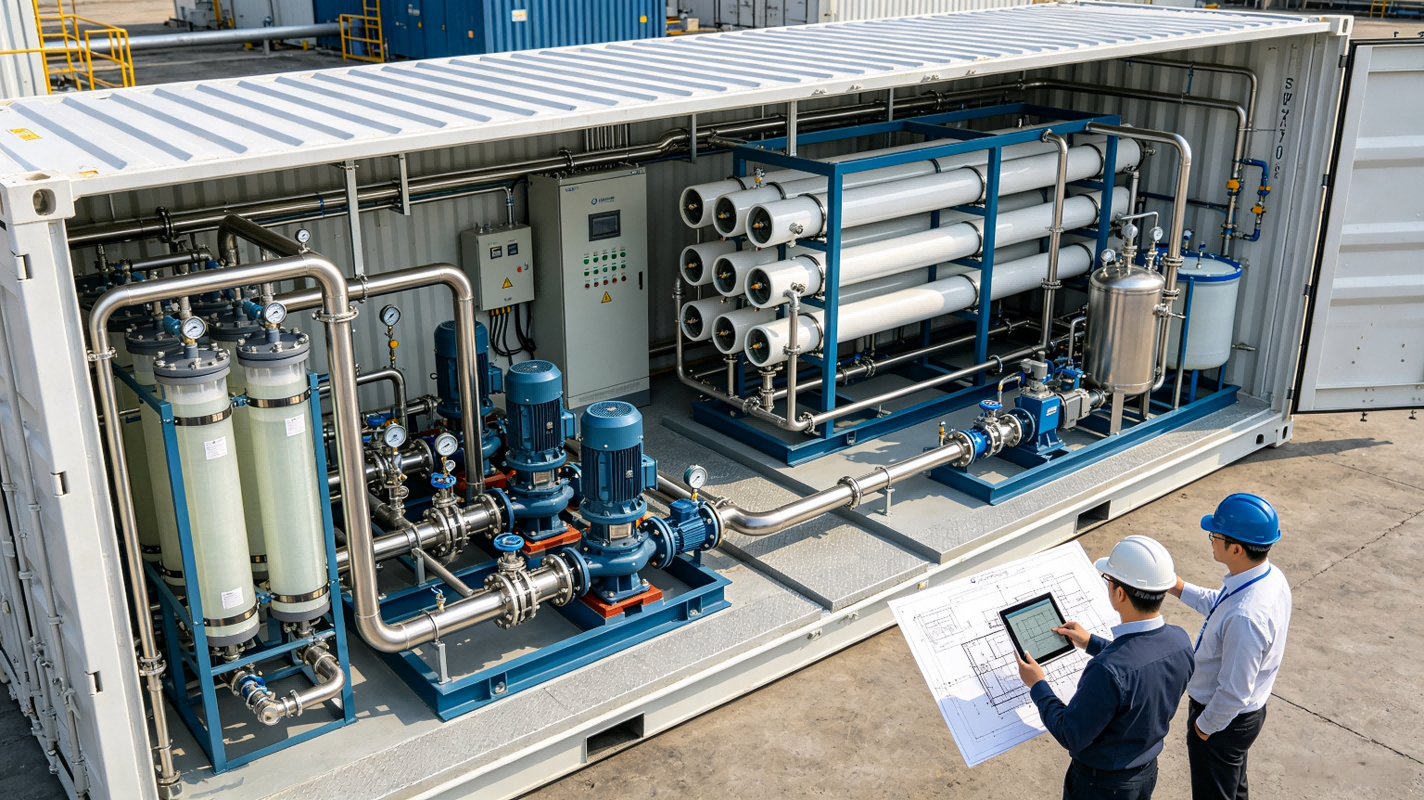
The first step in engineering design is determining the required freshwater production capacity.
The system should be designed according to actual water demand rather than only selecting a standard equipment model.
Important factors include:
Number of users
Daily water consumption
Peak demand periods
Industrial water requirements
Storage capacity
Future expansion plans
For example, a small island community may require a compact daily production system, while a resort or industrial facility may need multiple SWRO modules operating together.
Correct capacity planning helps avoid unnecessary investment while ensuring stable water supply.
Container Layout and Space Optimization
Space utilization is one of the key engineering challenges in containerized desalination design.
Unlike traditional treatment buildings, containers provide limited internal space. Every component must be arranged carefully.
Engineers need to consider:
Equipment dimensions
Pipe routing
Electrical cabinet location
Maintenance clearance
Operator access
Ventilation requirements
Drainage design
A practical layout usually separates different functional areas:
Includes filtration equipment, dosing systems, and seawater conditioning components.
Includes high-pressure pumps, pressure instruments, and energy recovery equipment.
Contains membrane pressure vessels and associated piping.
Includes PLC systems, control panels, monitoring instruments, and communication equipment.
Good layout design improves operation safety and reduces maintenance difficulty.
Integration of SWRO Components Inside Containers
A containerized desalination system is not simply a collection of individual machines. The components must operate as one integrated system.
Pretreatment protects RO membranes by reducing:
Suspended solids
Turbidity
Organic matter
Microorganisms
Typical components include:
Multimedia filters
Cartridge filters
Ultrafiltration systems
Chemical dosing equipment
The pretreatment design depends on seawater quality and seasonal changes.
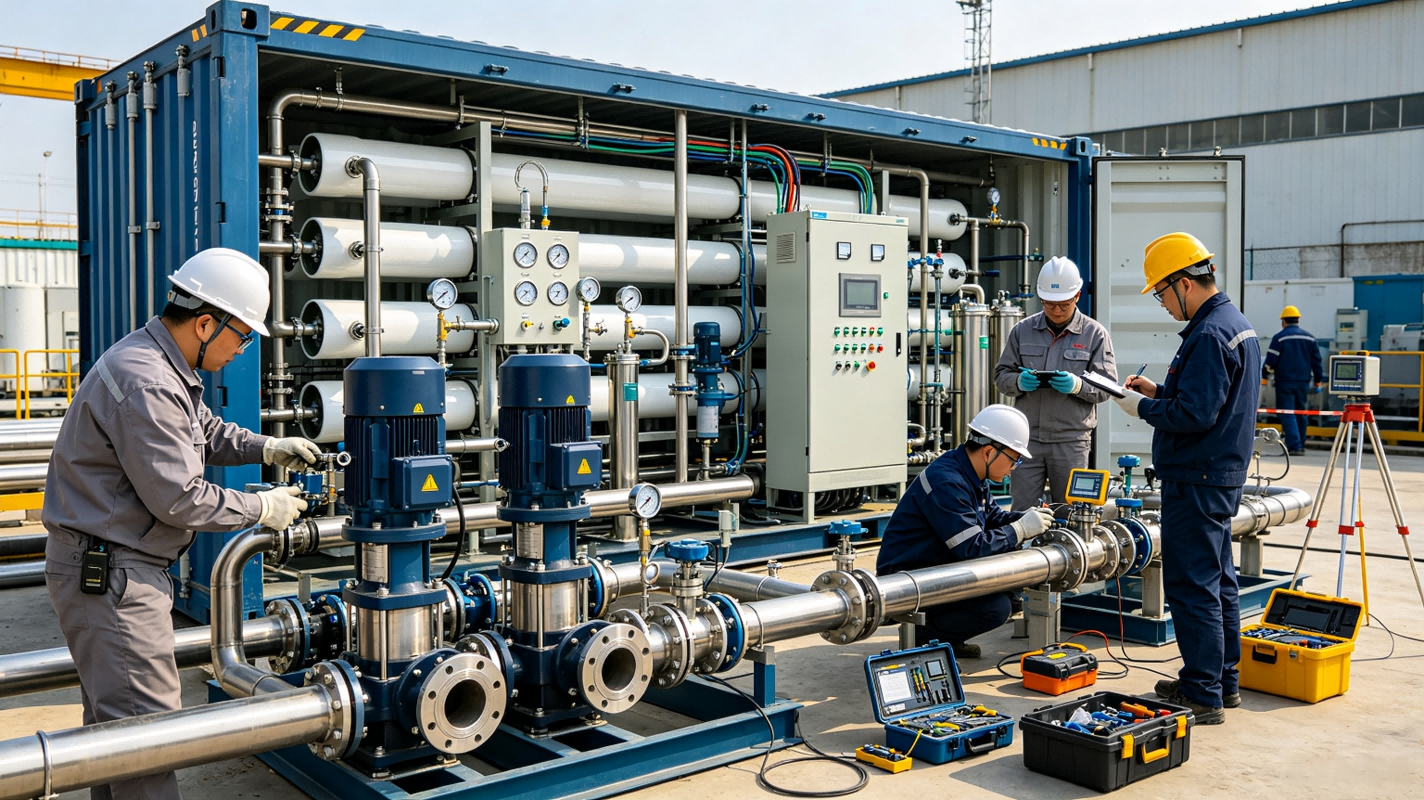
The high-pressure pump provides the pressure required for reverse osmosis.
During engineering design, engineers consider:
Required operating pressure
Energy consumption
Pump efficiency
Vibration control
Maintenance access
Because the pump is a critical component, its installation position and connection design directly influence system reliability.
The RO membrane section is designed according to:
Required production capacity
Seawater salinity
Recovery rate
Operating pressure
Available container space
Pressure vessels, piping, valves, and instruments must be arranged to maintain proper flow distribution.
Incorrect arrangement may lead to uneven membrane loading and reduced performance.
Piping Design in Containerized Desalination Equipment
Piping design plays an important role in compact SWRO systems.
Because the available space is limited, engineers must balance:
Short piping distance
Proper flow direction
Easy maintenance
Pressure resistance
Corrosion protection
Common piping materials may include:
Stainless steel
Duplex stainless steel
FRP
Engineering plastics
High-pressure sections require materials capable of handling both mechanical stress and seawater corrosion.
Proper pipe support, connection design, and vibration control are also important for long-term operation.
Corrosion Protection for Containerized SWRO Systems
Marine environments create significant corrosion challenges.
Containerized desalination equipment may operate in locations exposed to:
Salt spray
Humidity
Seawater contact
Temperature changes
Corrosion-resistant design should consider:
Equipment materials
Surface treatment
Fasteners
Pipe connections
Electrical protection
Container coating
The container itself should also provide suitable protection against weather and marine conditions.
For coastal and offshore applications, material selection is directly related to equipment service life.
Electrical and Automation Design
Automation is essential for modern containerized SWRO systems.
A control system can monitor and manage:
Feed pressure
RO pressure
Permeate flow
Conductivity
Temperature
Pump operation
Tank levels
Filter status
Typical automation components include:
PLC control systems
Touch-screen interfaces
Sensors
Flow meters
Pressure transmitters
Remote communication modules
For remote locations, remote monitoring can help operators identify abnormal conditions and improve maintenance efficiency.
Energy Requirements and Efficiency
Energy consumption is an important factor in seawater desalination.
The main energy-consuming component is usually the high-pressure pump.
Engineering design should consider:
Pump efficiency
Operating pressure
Recovery rate
Energy recovery equipment
Available power supply
For remote locations, the power source may include:
Grid electricity
Diesel generators
Solar energy
Hybrid energy systems
The desalination system should be designed according to the available energy conditions.
Containerized SWRO Applications
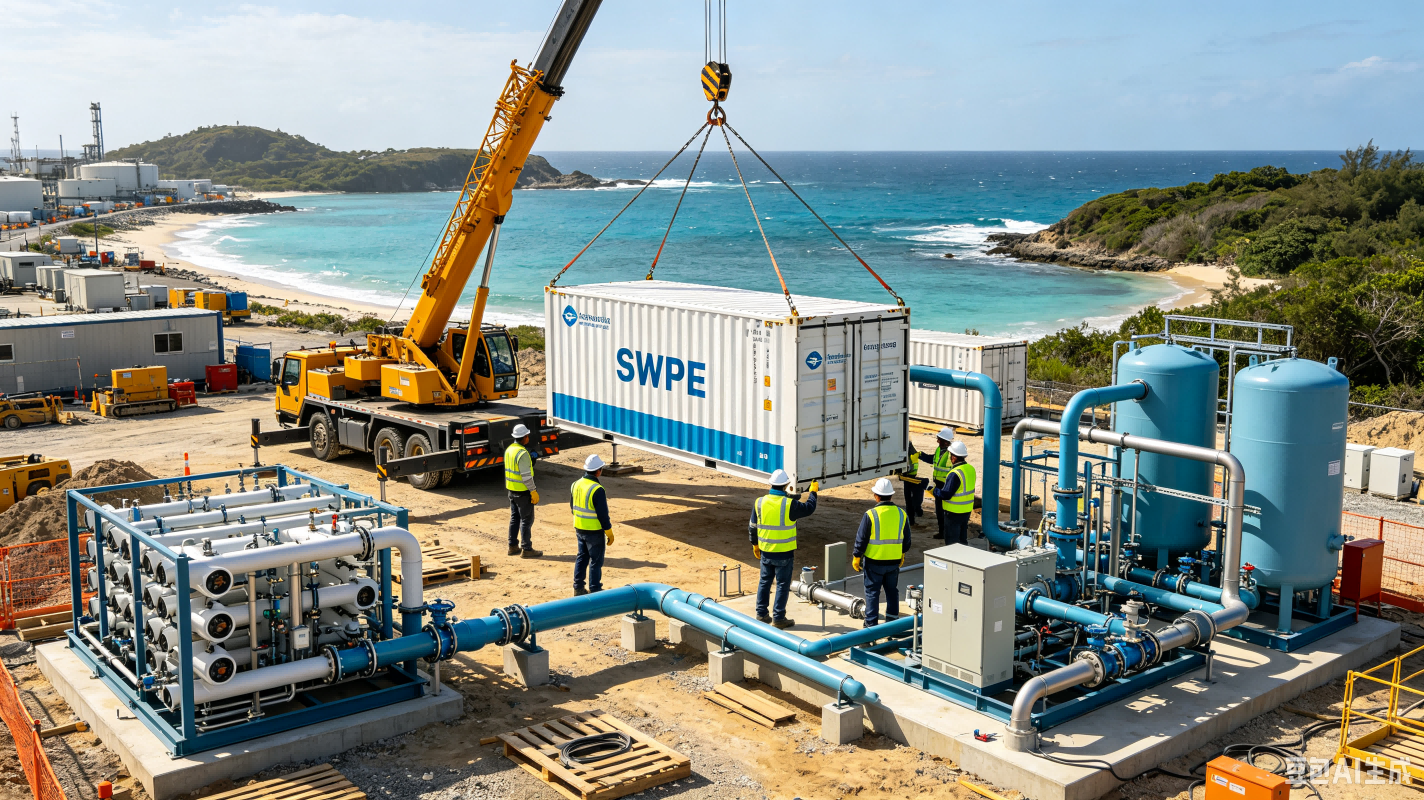
Many islands have limited freshwater resources.
Containerized desalination equipment can provide a practical solution by producing freshwater locally from seawater.
Applications include:
Island villages
Resorts
Tourist facilities
Remote communities
Offshore platforms and vessels often require compact freshwater systems.
Containerized SWRO units can be installed on:
Offshore platforms
Supply vessels
Floating facilities
The modular structure helps reduce installation complexity in marine environments.
Natural disasters and emergency situations may damage traditional water infrastructure.
Containerized desalination systems can be transported quickly to provide temporary freshwater production.
Applications include:
Coastal emergency response
Disaster recovery
Temporary construction projects
Factory Testing and Commissioning
Before delivery, containerized SWRO equipment is often tested to verify system performance.
Testing may include:
Pump operation
Pressure testing
Flow testing
Electrical inspection
Control system verification
Instrument calibration
Factory testing helps identify installation issues before transportation.
After arriving at the project site, engineers perform commissioning activities including:
Equipment connection checks
Seawater intake testing
System flushing
Operating parameter adjustment
Water quality verification
Maintenance Considerations
Although containerized systems simplify installation, regular maintenance remains important.
Common maintenance activities include:
Cartridge filter replacement
Pump inspection
Instrument calibration
Chemical dosing checks
Membrane performance monitoring
Pipeline inspection
Operators should regularly monitor:
Permeate flow
Conductivity
Differential pressure
Feed pressure
Salt rejection
Changes in these parameters may indicate fouling, scaling, or equipment problems.
Custom Engineering for Different Projects
Every desalination project has different requirements.
A customized containerized SWRO design may consider:
Freshwater demand
Seawater salinity
Temperature
Installation location
Power availability
Space limitations
Maintenance capability
Environmental requirements
For example:
A remote island may prioritize simple operation and reliable freshwater production.
An offshore project may require stronger corrosion protection and vibration resistance.
An industrial facility may focus on continuous operation and higher production capacity.
Customized engineering ensures that the desalination system matches the actual operating environment.
Conclusion
Containerized seawater desalination equipment provides a flexible approach for producing freshwater in locations where traditional desalination infrastructure may be difficult to build.
Through integrated engineering design, SWRO components including pretreatment, high-pressure pumps, RO membranes, automation systems, and storage connections can be combined into a compact and transportable solution.
However, successful containerized desalination depends on careful consideration of equipment layout, seawater conditions, material selection, energy supply, maintenance access, and long-term operation requirements.
For islands, offshore facilities, remote industries, and emergency water projects, a properly engineered containerized SWRO system can provide a reliable freshwater supply with flexible installation and practical operation.
Этот веб-сайт использует файлы cookie, чтобы обеспечить вам максимально эффективное использование нашего веб-сайта.
 English
 Portugues
 Français
 العربية
 ไทย
ไทย Indonesia
 Melayu
 Tiếng Việt
 中文
中文 қазақ
қазақ עִברִית
 မြန်မာ
 ພາສາລາວ
 Filipino
 o'zbek
 Кыргызча
 тоҷикӣ
 ខ្មែរ
ខ្មែរ Türkmenler



 телефон
Комментарий
(0)